🌳 Vermont Hardwood Flooring Blog · Updated
Wide Plank Flooring on Concrete Slabs
What works, what to test first, and how it’s installed

The short answer: the best wide plank floor for a concrete slab is a 3/4″ engineered plank with a thick sawn wear layer and a plywood core, glued directly to the slab. Solid hardwood can’t be glued straight to concrete; it needs a wood subfloor on top of the slab first.
Key takeaways
- Choose engineered for direct-to-concrete, basements and other below-grade rooms.
- Look for a sawn wear layer of 4 mm or more so the floor can be refinished like solid.
- A cross-banded plywood core keeps wide planks flat when the slab and the room change temperature and humidity.
- Test the slab for moisture and flatness before anything is installed.
- Engineered glue-down floors also work over in-slab radiant heat.

Why Concrete Is Hard on Wood Floors
Concrete holds moisture for a long time and gives it off from below. A solid plank glued to it can swell from the bottom and cup, and nails have nothing to hold. A roll-on moisture barrier such as WAKOL PU 280 reduces the risk of moisture coming up from the slab, but we still don’t recommend gluing solid flooring directly to concrete. Solid over a slab needs a plywood subfloor, which adds height, cost and a step in the schedule. For the full side-by-side, see our guide to solid vs engineered hardwood flooring.
Engineered flooring is built to handle this. Its core is thin wood plies glued with the grain running in alternating directions, so it resists the swelling and shrinking that a solid board goes through.
What to Look For in an Engineered Plank for Concrete
| What to check | Why it matters | Vermont Plank Flooring engineered |
|---|---|---|
| Wear layer | Sets how many times the floor can be sanded. Many engineered floors have 1–3 mm. | Approx. 5.2 mm, sawn from the same boards as our solid flooring |
| Core | Plywood holds glue and stays flat; voids or fiberboard can telegraph or swell. | 15 mm cabinet-grade birch plywood, 11 void-free plies |
| Overall thickness | 3/4″ sits flush with solid floors in the rest of the house. | 3/4″ |
| Width and length | Open plans and long rooms look best with wide, long boards and fewer seams. | Up to 12″ wide; lengths up to 14+ ft in most species |
| Indoor air | A slab floor covers a lot of square footage. | Certified low-emitting to CDPH v1.2; formaldehyde-free adhesive |
How Engineered Wide Plank Is Installed on Concrete
Your installer will follow the NWFA Installation Guidelines and the adhesive maker’s instructions. In outline:
- Condition the space. Heat or air conditioning running, with the room at normal living conditions before the flooring arrives.
- Test the slab. Measure concrete moisture with the method the adhesive maker specifies, and check flatness. New slabs need time to dry, so test rather than guess.
- Prepare the surface. Grind high spots, fill low spots, and clean off dust. Roll on a moisture barrier if the test calls for it (we suggest WAKOL PU 280 or similar).
- Set an anchor row the day before, so the floor doesn’t shift while the rest goes down.
- Glue down with full-spread adhesive. Lay out 100 sq ft or less at a time, trowel the adhesive (we suggest WAKOL MS 290 or similar), and set planks into it while it’s wet. Weigh them down so the rows stay tight while it sets.
- Keep humidity at 35–55% year-round after installation. This is also a condition of our warranty.
Full details are in our Installation & Adhesive Guidelines (PDF). Vermont Plank Flooring makes and supplies the flooring; installation is done by your installer.
Concrete Slabs With Radiant Heat
In-slab radiant heat and engineered wide plank work well together. The plywood core stays stable as the floor warms and cools, and glue-down puts the wood in direct contact with the heat. See our guide to wide plank flooring over radiant heat for temperature limits and start-up.
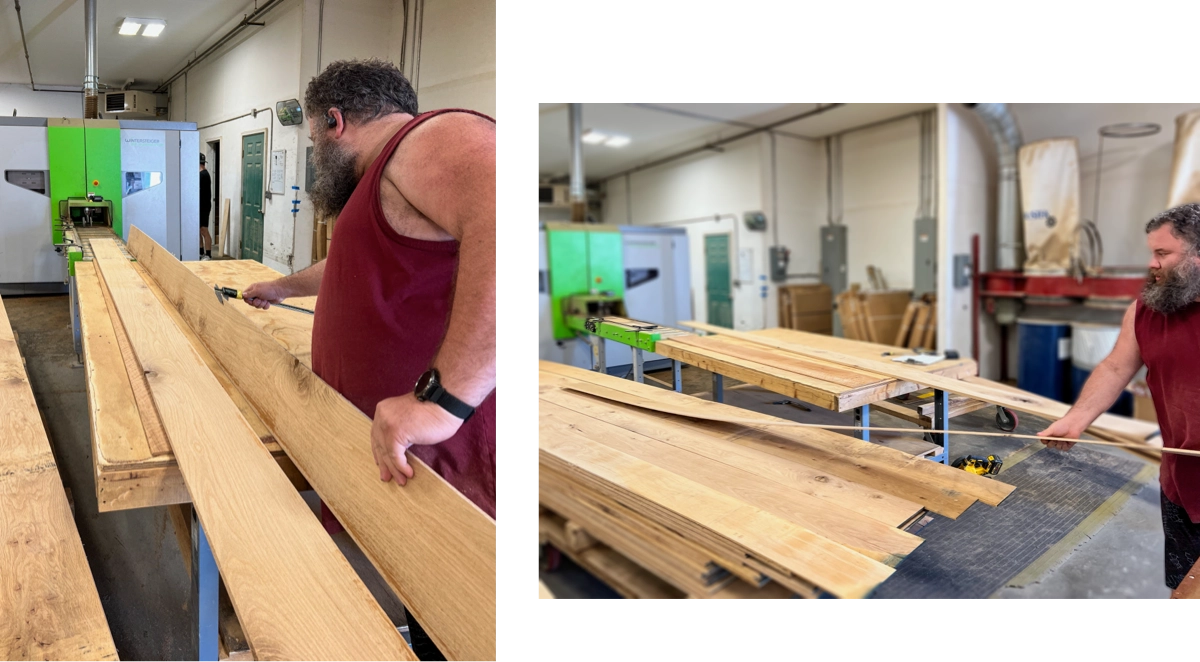
How Vermont Plank Flooring Builds for Concrete
We mill every engineered plank ourselves in Brattleboro, Vermont. The wear layer is cut from the same rough lumber we use for our solid floors, so an engineered White Oak floor on a slab looks the same as solid White Oak upstairs. Engineered flooring starts at $12 per square foot unfinished and comes unfinished, Finish Ready or prefinished in our shop.
See engineered flooring or call (802) 441-0981.
Frequently Asked Questions
Can you put hardwood flooring directly on concrete?
Engineered hardwood, yes: it can be glued directly to a properly prepared slab. Solid hardwood needs a plywood subfloor over the concrete first.
Can wide plank flooring go in a basement?
Engineered wide plank is suitable below grade when the slab passes a moisture test and the space is kept at 35–55% humidity.
Do I need a moisture barrier on concrete?
It depends on the slab’s moisture test. If the reading is above the adhesive maker’s limit, a roll-on barrier such as WAKOL PU 280 goes down first.
How wide can engineered planks be on concrete?
Ours go up to 12″ wide in most species (11″ in Heart Pine, 10″+ in Maple).
Can an engineered floor on concrete be refinished?
With a thick sawn wear layer, yes. Ours (approx. 5.2 mm) can be sanded and refinished multiple times, about the same as solid.
Does Vermont Plank Flooring install?
No. We make and ship the flooring; your installer puts it down. We’re happy to talk through the job with them.