🌳 Vermont Hardwood Flooring Blog · Updated
Solid Hardwood vs Engineered Flooring: Which Is Right for You?
How they differ, how we make both, and how to choose

The short answer: Solid hardwood is one piece of wood from top to bottom. Engineered hardwood is a real hardwood top layer bonded to a stable plywood core. Both look and feel like hardwood once installed, and our solid and engineered floors can be sanded and refinished about the same number of times. Solid comes wider, up to 19″. Engineered is more stable, so it’s the better pick for concrete slabs and basements.
We make both at our mill in Brattleboro, Vermont, from the same Northeastern timber. So we have no reason to push you toward one or the other. This guide lays out the real differences so you can choose the right floor for your home.
Key takeaways
- Both are 100% real wood on the surface. You walk on the same species, grain and finish either way.
- Refinishing is effectively equal. A solid plank can only be sanded down to its tongue, and our 5.2 mm wear layer reaches to just above it.
- Engineered wins on stability. It can be glued straight to concrete and installed below grade, as long as indoor humidity stays above 35% in winter.
- Solid wins on width: up to 19″ in some species, versus 12″ for engineered. Both work over radiant heat.
- Our engineered starts at $12 per sq ft. Solid starts at $10 per sq ft in character grade.
Solid vs Engineered at a Glance
| Solid hardwood | Engineered hardwood | |
|---|---|---|
| Construction | One piece of hardwood | 5.2 mm sawn hardwood wear layer on a 15 mm, 11-ply birch plywood core |
| Total thickness (our floors) | 3/4″ (19 mm) | 3/4″ (19 mm) |
| Widths we make | 4″ to 15″+ (up to 19″ in Eastern White Pine) | 4″ to 12″ |
| Refinishing | Can be sanded down to the tongue | Effectively the same: our 5.2 mm wear layer reaches to just above the tongue |
| Stability | Good; moves more with seasonal humidity | Excellent; cross-banded core resists cupping and gapping |
| Very dry conditions | Boards shrink and gaps open between them | Not recommended below 35% humidity: the wear layer can check (fine surface cracks) as it shrinks against the stable core |
| Over concrete | Not recommended directly on a slab | Full-spread glue, direct to slab |
| Below grade (basements) | No | Yes |
| Radiant heat | Yes | Yes |
| Installation | Nail or staple with glue assist (4–8″); full-spread glue with nail assist (9″+) | Same as solid over wood; full-spread glue on concrete |
| Our price | From $10 per sq ft (character grade) | From $12 per sq ft |
| Warranty | Lifetime structural | Lifetime structural, including delamination |
Prices are for unfinished flooring. See each species page for current pricing by grade.
How Solid and Engineered Flooring Are Made
What is solid hardwood flooring?
Solid hardwood flooring is milled from a single board of hardwood, with a tongue and groove cut into its edges. At our mill we start with kiln-dried Northeastern timber, rip it to width, and mill each plank to a 3/4″ thickness with a tolerance of three thousandths of an inch. Because it’s wood all the way through, a solid floor can be sanded down and refinished several times over the life of the house.
What is engineered hardwood flooring?
Engineered hardwood flooring has a top layer of real hardwood, called the wear layer, bonded to a core of cross-banded plywood. The layers run in alternating directions, so the core resists the swelling and shrinking that solid wood goes through with the seasons.
Not all engineered flooring is built the same. A typical engineered floor has a 1–3 mm wear layer, often rotary-peeled or sliced, on a 3- to 9-ply core that often has voids. It’s usually 3/8″ to 5/8″ thick overall and 5″ to 7½″ wide. Ours is built differently (full specs and pricing are on our engineered hardwood flooring page):
- Sawn wear layer. About 5.2 mm of solid hardwood, sawn from the same boards we use for our solid flooring. Because it’s sawn rather than peeled, it shows the same natural grain as a solid board.
- Cabinet-grade birch core. 15 mm birch plywood, 11 void-free cross-banded plies. (Eastern White Pine, a softer species, gets a thicker 6.5 mm wear layer on a 12 mm, 9-ply core.)
- Full 3/4″ thickness. The same as solid, tongue and groove and end-matched, so it installs with standard methods and sits flush against existing 3/4″ floors.
- Clean bond. Formaldehyde-free, CARB 2 compliant hot-melt adhesive. Our engineered flooring is also certified low-emitting to California’s CDPH v1.2 standard.
How we build an engineered plank
- Cutting the lamellas. In our lamella room, a band saw slices 22 mm thick boards into 6.4 mm slices, called lamellas. Two passes give three identical lamellas, with 1.4 mm lost to the blade on each pass.
- Cutting the core. A beam saw rips 4 x 8 ft sheets of 15 mm cabinet-grade birch plywood into strips that match the lamellas, up to 12″ wide.
- Gluing and pressing. Hot-melt glue heated to 295°F is rolled evenly onto the plywood. Each lamella is laid on top, and a five-roller press bonds them at 1,000 psi.
- Testing the bond. We cut samples and alternately soak them in water and heat them in ovens, checking for any adhesion failure.
- Milling. A flying saw cuts the planks to length. Then our molder mills them to 3/4″ with a tongue and groove and end-matching, leaving a finished wear layer of about 5.2 mm.
See more of our production process.
Same timber, same mill
The wood you walk on is the same whether you pick solid or engineered. We select the timber, then mill both products in-house in Brattleboro, Vermont. Your choice comes down to what’s underneath, not how the floor looks.
Durability, Refinishing and Lifespan
Day to day, solid and engineered wear exactly the same. Scratch and dent resistance come from the species and the finish, not from what’s under the surface. A white oak floor with a good finish holds up the same either way.
What limits refinishing is the wood above the tongue and groove. A solid plank can only be sanded down to the top of its tongue. Past that point the tongue and groove are exposed and the floor is done.
- Solid: sanded down to the tongue.
- Our engineered: the 5.2 mm sawn wear layer reaches to just above the tongue line. That gives it effectively the same sanding life as our solid floor.
- Thin-veneer engineered: a 1 mm wear layer can usually only be recoated, and 2–3 mm allows one or two full sandings. That’s where engineered got its reputation for not lasting.
How many times any floor can be sanded depends on the original finish, how flat the floor is, and how much wood each sanding takes. Most floors don’t need a full sanding often. A screen and recoat every several years, which removes no wood, keeps the finish fresh.
Moisture, Subfloors and Radiant Heat
All wood takes on and gives off moisture as indoor humidity changes. Solid planks expand across their width in humid summers and shrink in dry winters. Engineered flooring’s cross-banded core keeps that movement much smaller. For either floor, keep indoor humidity between 35% and 55% year-round.
Concrete slabs and basements. This is where engineered clearly wins. It can be glued directly to a concrete slab with a full-spread adhesive, with no plywood subfloor, and it’s suitable below grade. Solid needs a wood subfloor above grade. Read our guide to wide plank flooring on concrete.
Radiant heat. Both our solid and engineered floors are rated for radiant heat. The keys are a well-controlled system, gradual temperature changes and steady indoor humidity. See our guide to wide plank flooring over radiant heat.
Very dry conditions. This is engineered’s weak spot. If indoor humidity stays below 35%, the solid wood wear layer tries to shrink while the plywood core holds its shape. That can cause checking: fine cracks in the surface. Solid boards shrink too, but they open gaps between boards instead. Northeastern homes often drop below 20% humidity in winter, so with engineered we recommend an in-line or stand-alone humidifier. If your home can’t stay above 35%, choose solid.
Kitchens and bathrooms. Both are fine in kitchens with normal care. Neither is a good choice where standing water is routine.
We make flooring and don’t install it, but we’re happy to talk through your subfloor with you or your installer. Our installation and adhesive guidelines cover both floor types.
Wide Planks: Width, Length and Stability
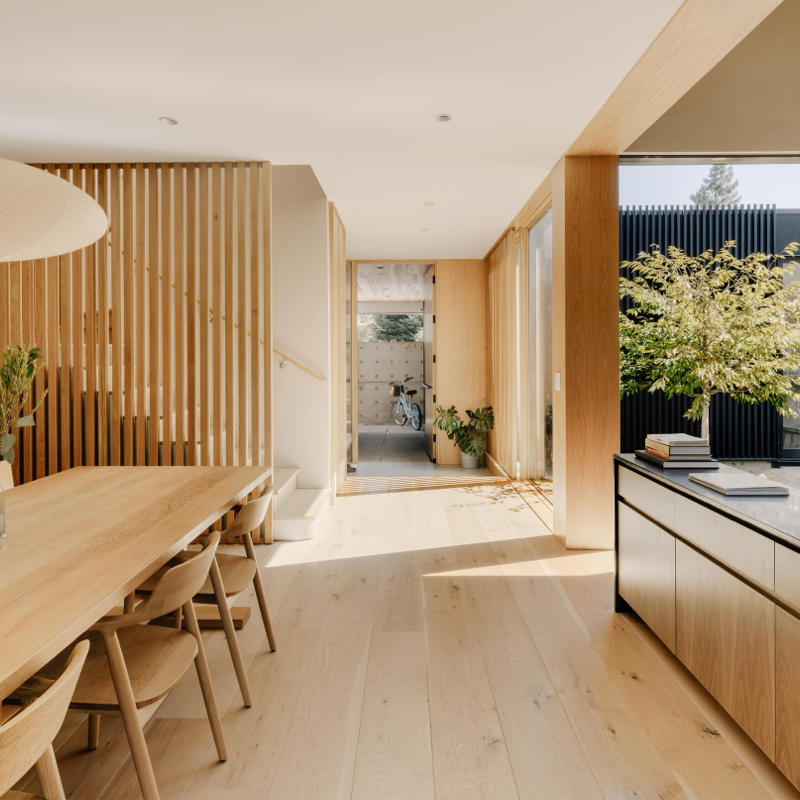
Wide planks are what we do, and both floor types come wide.
- Solid: most species from 4″ to 15″ and wider, with Eastern White Pine up to 19″. Planks run up to 14 ft and longer, depending on species.
- Engineered: up to 12″ wide in most species (Maple to 10″+, Heart Pine to 11″), and up to 14 ft and longer.
The wider a solid plank, the more it moves with seasonal humidity, because wood moves across its width. That’s why very wide solid planks are installed with full-spread glue and nails and need steady humidity. Engineered’s core keeps wide planks flatter, so many customers choose it for 10″ to 12″ floors, especially over radiant heat or concrete. For more, read our guide to keeping wide plank flooring stable.
Because both our floors are 3/4″ thick, solid and engineered can meet at the same height. That’s handy when one part of a house is over a slab and the rest is over wood framing.
Cost
At big-box stores, engineered is usually the cheaper option because the wear layer is thin. A well-built engineered floor with a thick sawn wear layer costs about the same as solid, and for some species more, because of the extra material and manufacturing steps.
Our prices, unfinished, per square foot:
- Solid: from $10 in character grade, depending on species. White oak runs $13 to $28 (see White Oak).
- Engineered: $12 to $28, depending on species, grade and width.
- Our most popular floors run between $14 and $18 unfinished. Finish Ready (pre-sanded, knots filled) adds about $2, and prefinishing in our shop adds about $6.
Width, grade, cut and species move the price more than the choice between solid and engineered. Look at the whole project, too. Over a concrete slab, engineered glued directly down can save the cost of building a plywood subfloor. See current prices on each species page or request a quote.
Sustainability
Both floors can be a responsible choice. Each has its own advantage:
- Solid is wood all the way through, with no core or adhesive. A floor that’s sanded and refinished instead of replaced keeps its wood in use for generations.
- Engineered makes the old growth go further. Each 22 mm board we saw yields three wear layers, so the same slow-grown timber covers about three times as much floor.
Whichever you choose, ours is milled from timber from sustainably managed Northeastern forests. Our mill is FSC and SFI certified, FSC material is available on request, and the plant runs on about 437 kW of rooftop solar. Our engineered flooring is certified low-emitting to CDPH v1.2, and every finish we use is formaldehyde-free. Learn more about our sustainability practices.
Which Is Right for Your Project?
| Your situation | Our usual recommendation |
|---|---|
| Over a concrete slab | Engineered, glued direct to the slab |
| Basement or other below-grade room | Engineered |
| Over radiant heat | Either. Engineered gives extra stability at wide widths |
| Planks wider than 12″ | Solid (engineered tops out at 12″) |
| 10″–12″ planks in a home with big humidity swings | Engineered |
| Plywood subfloor, above grade, steady humidity | Either; it comes down to width and preference |
| Historic home or restoration | Solid, to match original construction. See Heart Pine and Eastern White Pine |
| Floor must match an existing 3/4″ floor’s height | Either; both of ours are 3/4″ |
| Home that can’t keep humidity above 35% in winter | Solid |

Still deciding? Order samples of the same species in solid and engineered and compare them side by side. You won’t be able to tell them apart from the top. For the rest of the decision, from species to grade to cut, see our guide to choosing a wide plank floor.
Frequently Asked Questions
Is engineered hardwood real wood?
Yes. The surface is a layer of real hardwood, and the core is plywood made from wood veneers. Ours has a 5.2 mm sawn hardwood wear layer cut from the same timber as our solid flooring.
Is solid hardwood better than engineered?
Neither is better in every case. Solid comes wider, up to 19″. Ours can be refinished about the same number of times either way. Engineered is more stable and can go over concrete and below grade. The right choice depends on your subfloor, climate and plank width.
Is engineered hardwood more durable than solid?
They resist scratches and dents equally, because that comes from the species and finish. With our 5.2 mm wear layer, both have effectively the same wood to sand over their lifetime. Engineered handles humidity changes better.
Can you tell the difference between solid and engineered once installed?
Not from the surface. With a sawn wear layer like ours, the grain, color and texture look the same as solid. Both of our floors are 3/4″ thick and feel solid underfoot.
Can engineered hardwood be refinished?
Yes, if the wear layer is thick enough. Our 5.2 mm wear layer reaches to just above the tongue, so it can be refinished about as many times as our solid flooring. Wear layers of 1–3 mm allow a recoat, or one or two sandings at most.
Can solid hardwood go over radiant heat?
Yes. Both our solid and engineered floors are rated for radiant heat, with a well-controlled system and steady indoor humidity.
Can solid hardwood be installed on concrete?
We don’t recommend solid directly on a slab. Use engineered glued to the slab (see our concrete guide), or install solid over a plywood subfloor built above the concrete.
Which costs more, solid or engineered?
Our engineered starts at $12 per sq ft and our solid at $10 in character grade. Species, grade and width affect the price more than the construction does.
Ready to Compare Them in Person?
Order samples of the same species in solid and engineered, or talk through your subfloor and climate with one of our flooring specialists. Request samples, book a consultation or call (802) 441-0981. Already leaning engineered? See full specs, widths and pricing for our wide plank engineered hardwood flooring.